

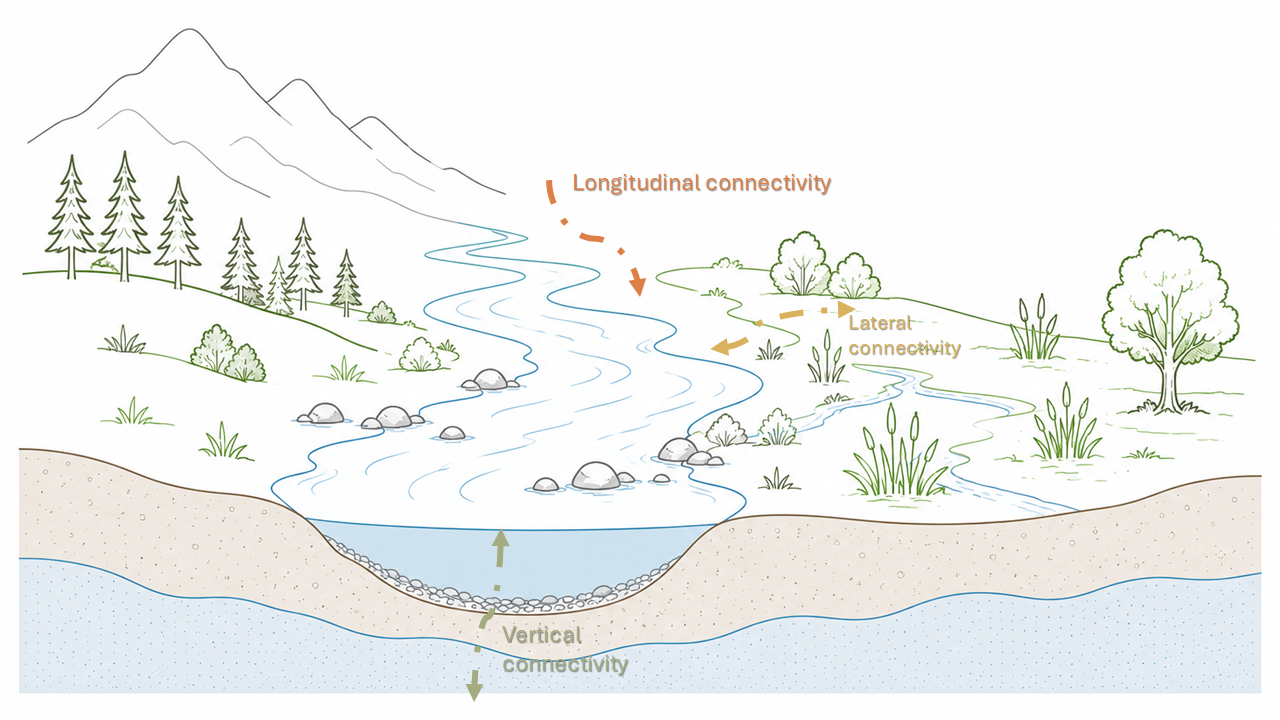
Rivers are living, dynamic ecosystems. Their natural functioning depends on three fundamental dimensions of connectivity:
- Longitudinal connectivity, allowing the uninterrupted movement of water, sediment and aquatic organisms from the headwaters to the river mouth,
- Lateral connectivity, linking the river channel with its riparian zone and floodplain,
- Vertical connectivity, maintaining the exchange between surface water and groundwater
These three dimensions sustain biodiversity, maintain healthy river ecosystems and support the ecological integrity of rivers.
Artificial barriers do far more than obstruct the flow of water. They can disrupt the natural functioning of entire river ecosystems by:
- restricting the movement of fish and other aquatic organisms;
- interrupting the natural transport of sediment;
- altering the natural flow regime;
- disconnecting rivers from their floodplains;
- fragmenting habitats and reducing biodiversity.
Within the project Phragmographysis, all artificial barriers affecting the longitudinal connectivity of the Diarizos river network are identified and assessed, including dams, weirs, sluices, culverts and fords. Although many of these structures continue to serve important societal functions, they may also significantly affect the ecological functioning of the river.
As part of the project, field surveys are carried out throughout the Diarizos river network. Every barrier is mapped and assessed using a standardised field protocol to evaluate its impact on river connectivity and to identify opportunities for future restoration.
Restoring river connectivity is a key priority for the European Union. The Nature Restoration Regulation calls on Member States to restore free-flowing rivers, including through the removal of obsolete river barriers, where this is ecologically beneficial and technically and socially feasible. Phragmographysis directly contributes to this objective by delivering the first comprehensive inventory and assessment of river barriers in Cyprus, laying the foundations for future river restoration initiatives.
A free-flowing river is one in which water, sediment, nutrients and aquatic organisms can move naturally along the river corridor and interact with the surrounding floodplain and groundwater, without significant artificial barriers disrupting its natural ecological and hydromorphological processes
TYPES OF LONGITUDINAL RIVER BARRIERS
Artificial barriers vary in their design, function and the extent to which they affect river connectivity. Some permanently impound water and create reservoirs, while others are constructed to divert water, regulate flow or provide road crossings. Depending on their characteristics, they may affect the movement of aquatic organisms, sediment transport and the natural functioning of rivers to different degrees.
Dam
Dams are the largest engineered structures found in rivers. They obstruct the natural flow of water, create reservoirs and transform upstream river sections into standing or slow-flowing water bodies. They usually have the greatest impact on longitudinal connectivity by preventing the movement of aquatic organisms and interrupting sediment transport.
Weir
Weirs are generally smaller transverse structures over which water flows freely. They are commonly used for water diversion, abstraction, groundwater recharge, sediment retention or channel stabilisation. Depending on their height, design and flow conditions, they may represent a significant barrier to fish and other aquatic organisms.
Sluice
Sluices incorporate one or more movable gates that regulate water level and discharge. They are primarily used in water abstraction schemes, irrigation systems and canals. Their effect on river connectivity depends on both their design and operational regime.
Culvert
Culverts are structures that convey rivers or streams beneath roads and other infrastructure. Although they do not create impoundments, they can become barriers to aquatic organisms when they are perched above the streambed, when water depth is insufficient, or when flow velocities are excessively high.
Ford
Fords provide shallow crossings that allow vehicles or pedestrians to pass directly through the river channel. While they generally have little effect on sediment transport, they may impede the movement of fish and other aquatic organisms, particularly during periods of low flow.
Bridge
When properly designed, bridges allow rivers to flow freely beneath them and generally do not obstruct river connectivity. However, bridge piers and associated engineering works may alter channel morphology and locally affect the movement of aquatic organisms.